
PLAN SOMETHING WORTH CELEBRATING
Traditional 7-point star piñata: meaning, colors and how to order one
Plan a star piñata for a posada or any celebration: what the seven points traditionally stand for, which colors and core to choose, and when to order.
Quick answer
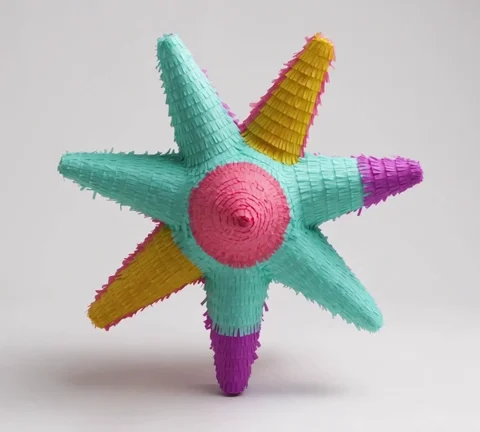
A traditional star piñata has seven points. In the traditional interpretation, they stand for the seven deadly sins, and breaking the piñata at a posada (December 16–24) symbolizes overcoming them, with the fruit and candy as the reward. In Mexico, the original was a clay pot covered in paper; many stars today are cardboard or papier-mâché.
By the All Pinatas team · Updated
Marketplace coming soon. Orders and payments are not open yet.
What does a 7-point star piñata mean?
The posadas are celebrated in Mexico from December 16 to 24: nine nights that recall Mary and Joseph asking for lodging, with songs at the door, food and a piñata. The nine nights are often explained as the nine months of Mary's pregnancy. Dates can vary by region; Mexico's National Institute of Indigenous Peoples (INPI) describes Nahua communities in Guerrero holding posadas from December 10.
Mexico's National Institute of Anthropology and History (INAH) traces the posadas to the second half of the 16th century, when Augustinian friars in Acolman, in today's State of Mexico, held misas de aguinaldo, Christmas-season masses that grew into the posadas. INAH calls Acolman the cradle of the piñata. According to INAH and Mexico's Secretaría de Cultura, the early piñata was a clay pot filled with fruit and candy, covered in colored paper, with seven points.
The traditional interpretation, repeated by Mexican cultural and government sources, reads the piñata as a lesson:
- The seven points stand for the seven deadly sins: pride, greed, lust, wrath, gluttony, envy and sloth.
- The bright colors represent temptation.
- The blindfold stands for blind faith, and the stick for virtue, or the strength to overcome temptation.
- The fruit and candy that fall are the reward of the kingdom of heaven.
Traditional fillings include seasonal fruit such as tejocotes, jícama, sugarcane, oranges and limes, plus peanuts and candy. It is a symbolic reading, not a rule: star piñatas are used for birthdays and other parties too.
How do I choose the colors and number of points?
Seven points is the classic posada star, but it isn't the only shape. Tell the maker how many points you want, your colors, tissue finish, streamers and desired overall size. Share a reference photo for the style rather than assuming every traditional star has the same shape or construction.
- Points: seven for the traditional look. Ask whether the cones are hollow and part of the fill space, or decorative cones attached to the body.
- Colors: bright, contrasting paper is the traditional look. Christmas colors such as red, green, gold and white suit a posada; for a birthday, match the party. You can also ask for each point in a different color.
- Finish: fringed tissue paper (papel de china), metallic foil, or a mix. Foil catches the light; tissue gives a soft, layered look.
- Streamers: tails of tissue or ribbon at the tips add movement. Ask how long they will be, because long tails can tangle in the rope or drag on the ground.
Clay pot or cardboard: what is a traditional star made of today?
The original posada piñata was built on a clay pot, or olla. Mexico's Secretaría de Cultura notes that piñatas are no longer made only on clay pots but entirely from cardboard, some with a pre-made opening. A Mexican agriculture ministry article (SIAP) says clay piñatas can still be found in towns across the country. Ask a maker which they build rather than assuming.
| Core | What it is | Things to weigh |
|---|---|---|
| Clay pot (olla) | The traditional base, covered in paper, with cone points | Heavier, and breaks into hard pieces. Better as a display piece or a closely supervised adult game, and the hanging system must be documented for the weight. |
| Cardboard | A cardboard body or silhouette with paper cones | Lighter. Can be built as pull-open or strike-open; resistance depends on the maker's recipe. |
| Papier-mâché | Layers of paper and paste over a form | Strength depends on materials, drying and construction, not just the number of layers. |
If children will be swinging at it, a paper or cardboard core built to the right opening level for the age group is the practical choice. If you want an olla for tradition, say so early and ask how the maker handles weight, hanging and cleanup.
What size star piñata do I need?
Measure the center and the complete shape. The center cavity usually matters more for fill planning than the distance from tip to tip, because long points add width without adding much usable space. Ask the maker for usable cavity measurements and the approved fill limit, then check quantities with the candy capacity calculator.
- Size bands: our design brief uses roughly 18–24 inches (45–60 cm), 25–36 inches (65–90 cm) and over 36 inches (90 cm+). Ask whether the maker measures tip to tip or the body only.
- Space: a wide star needs clearance on every side when it swings or turns, plus room above the hanging point.
- Transport: long points can change the shipping box and packaging needs, and a large star may not fit on a back seat. Measure your car before pickup, or read our guide to shipping a piñata without damage.
Should the star be for display or for breaking?
Plan display and opening separately. Confirm whether the star is a display piece, a pull-open design or a strike-open design, because each is built differently.
- Display: can carry longer points, foil and delicate details. A good choice if you want to keep it after the season.
- Pull-open: ribbons release the opening, so nobody swings. Useful with small children, indoor posadas and crowded patios.
- Strike-open: the classic posada game. It needs a controlled opening area and a separate, documented hanging attachment.
Decorative points and streamers should not be mistaken for suspension points. Follow the product's documented hanging and use instructions, and if you want both a keepsake and a game, consider two pieces.
When should I order a star piñata for a December posada in Phoenix?
Lead times are often 1–3 weeks, but ask the maker. December can be a busy month for piñata makers, because posadas, Christmas and end-of-year parties fall in the same few weeks, and many posadas share the same nine nights. For a custom star, a month ahead is a sensible target, and earlier if you need several.
- Give the maker your date, the number of guests and the youngest player's age.
- Confirm points, colors, size, core and opening method in writing, with a complete quote.
- Agree on pickup or delivery. December evenings in Phoenix are usually mild, so heat matters less than in summer, but keep the paper dry and protect the points in the car.
- Hosting several nights? Order the set together and confirm each date.
All Pinatas isn't taking orders yet. To compare local options now, read our guide to finding piñata makers in Phoenix, and join the launch waitlist for news.
Questions people ask
Does a star piñata have to have seven points?
No. Seven is the traditional posada form, but stars can be made with other point counts. Tell the maker the number you want and share a reference photo.
What goes inside a traditional posada piñata?
Traditionally, seasonal fruit such as tejocotes, jícama, sugarcane, oranges and limes, plus peanuts and candy. If young children will be there, check our age guide for fillers to skip.
Can I use a star piñata for a birthday?
Yes. The star shape works for birthdays and other celebrations, and the colors and size can follow the party theme rather than Christmas.
Are clay-pot piñatas still made?
Yes. A Mexican agriculture ministry article says clay piñatas can still be found in towns across Mexico. Many piñatas today are cardboard or papier-mâché, so ask a maker which they offer.
Can I order a star piñata on All Pinatas for this December?
Not yet. The marketplace is coming soon, and orders and payments are not open. You can join the waitlist for launch news.
Sources
- Acolman: cuatro siglos de posadas y tradicionales piñatas — Instituto Nacional de Antropología e Historia (INAH)
- La piñata, una colorida tradición de arraigo nacional — Secretaría de Cultura, Gobierno de México
- Las Posadas: Armonía y celebración — Instituto Nacional de los Pueblos Indígenas (INPI), gob.mx
- La piñata, símbolo de la cultura mexicana — Servicio de Información Agroalimentaria y Pesquera (SIAP), Secretaría de Agricultura, gob.mx
- Mexican Christmas Tradition: Posadas — Department of Hispanic Studies, University of Kentucky