
PLAN SOMETHING WORTH CELEBRATING
How do you ship a piñata? Box, packing and timing
Piñatas are big, light and full of fragile points. Plan the box, the packing and the delivery date together, before any label is printed.
Quick answer
To ship a piñata, pack it empty in a sturdy box with room for padding on every side, protect the cones, fringe and hanging attachment, then measure and weigh the closed box. Carriers often bill large, light boxes by dimensional weight, so get a current quote from those measurements and plan for arrival several days before the event.
By the All Pinatas team · Updated
Marketplace coming soon. Orders and payments are not open yet.
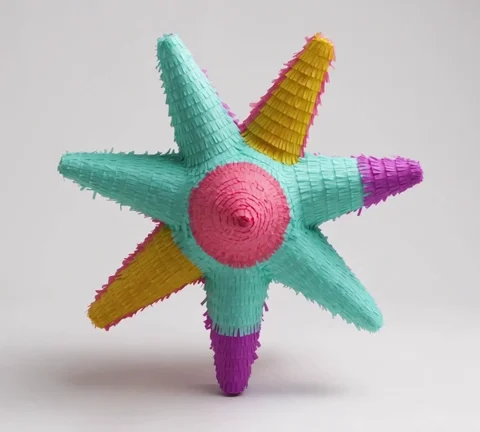
Why are piñatas hard to ship?
A piñata is an awkward parcel. It is bulky but light, so it takes up a lot of space for its weight. Its most eye-catching features, the cones on a star, the horns and tails on animals and the layers of fringe, are also its most fragile. And it is designed to break open, so a hard knock in transit can crack a seam that was meant to hold until the party.
That combination creates three common problems:
- Cost. A big, light box can cost far more to ship than its weight suggests.
- Damage. Points bend, fringe gets crushed flat, and hanging attachments can tear if they end up carrying the load inside the box.
- Timing. A piñata that arrives after the party is too late, however well it was made.
The piñata's own height does not solve any of these. A good shipping plan starts with the finished, closed box.
What size box do I need to ship a piñata?
Choose a sturdy box that fits the piñata with room for padding on every side, including the tips of the cones and any tail, horn or handle. As a rough starting point, leave a couple of inches (about 5 cm) of cushioning between the piñata and each wall, then test the fit. A box that is too tight presses on points and fringe; one that is too big lets the piñata shift and adds cost.
Once it is packed and sealed, record what a maker or carrier needs for a quote:
| What to record | Why it matters |
|---|---|
| Closed box length, width and height | Carriers price and check size limits from the outside of the box, not the piñata |
| Packed weight | It is compared with a size-based weight to set the billed weight |
| Origin and destination ZIP codes | Distance affects the rate and the transit time |
| Carrier service and date needed | Faster services usually cost more, and the date sets your ship-by day |
The piñata's own height is not enough for an accurate shipping quote. Measure the closed box at its widest points, including any bulges.
How do carriers price a big, light box?
Carriers may use dimensional weight and additional size charges. The idea behind dimensional weight is simple: a box takes up room on a truck or plane whether it is heavy or not. So the carrier works out a size-based weight from the box's length, width and height, compares it with the actual weight on the scale, and bills whichever is greater.
For a piñata, the size-based figure is often the one that counts. A box that weighs very little can be billed as if it were much heavier, simply because it is large. Very long or large boxes can also trigger extra handling or oversize charges.
The formulas, divisors and size thresholds differ by carrier and service, and they change, so rely on the carrier's current published rules or a live quote rather than a figure you saw elsewhere. Practical ways to keep the billed weight down:
- Use the smallest box that still leaves room for padding.
- Ask the maker whether any part is designed to be packed separately and attached on arrival.
- Compare services and delivery dates, not only carriers.
- Get the quote from the packed box, not from an estimate of it.
How should I pack a piñata to protect the cones and fringe?
The goal is to hold the body of the piñata still so the fragile parts never press against the box. A few packing habits help:
- Wrap cones, horns and other points in soft paper so they cannot rub or bend.
- Keep tape off the fringe and decorations; tape the wrapping, not the piñata.
- Support the piñata by its body, not its hanging loop, and fill empty space so it cannot slide.
- Protect the hanging attachment so it is not crushed, kinked or used as a handle in the box.
- Put loose items, such as pull strings or instructions, in a separate bag inside the box.
- Mark which side is up, knowing that carriers may not always follow it.
Makers can turn this into a repeatable checklist:
- Photograph the finished product and packing method.
- Protect fringe, points and hanging attachments with a documented package design.
- Measure and weigh the closed parcel.
- Validate the address and obtain a current carrier rate.
- After an authorized label purchase, record the tracking number and carrier acceptance.
A printed label does not mean the package has been accepted by the carrier. All Pinatas has not connected label purchasing yet. No label charges are active. If you make piñatas, the guide to selling as an All Pinatas maker lists the shipping evidence to have ready.
Should a piñata be shipped empty or filled?
In most cases, ship it empty and fill it after it arrives. Candy adds weight, which can raise the cost, and loose candy can shift and press against seams and the opening area in transit. The person receiving it can plan the filling with the candy capacity calculator, using the usable inside cavity and the documented hanging limit the maker provides.
If a filled piñata is truly needed, agree on it with the maker in advance, keep the fill within the documented limit and choose treats that tolerate heat.
Heat matters too. Packages can spend hours in hot trucks, warehouses and on doorsteps. In hot weather:
- Ship early in the week so the box is less likely to sit somewhere over a weekend.
- Arrange delivery for when someone is home, or to a place where it can be brought inside quickly.
- Leave chocolate and other melt-prone treats out of the box and buy them near the party.
- Open the box promptly and keep the piñata somewhere cool and shaded until it is time to hang it.
When should a shipped piñata arrive before the party?
Plan for arrival several days before the event, not the day before. That leaves room to deal with a delay, a damaged box or a design question while there is still time to fix it. A useful quote separates two clocks:
- Production time: how long the maker needs to build, finish and pack the piñata.
- Transit time: how long the carrier service takes after it accepts the package.
The quote should also confirm the shipping cost, carrier service, tracking, packaging and the process for reporting damage. Add production time, transit time and a buffer, then count backward from the party to find your order-by date. For a birthday, the birthday piñata planning guide has a simple timeline. Once it ships, watch the tracking until the carrier has actually accepted the package.
What should I do if a piñata arrives damaged?
Before you decide anything, document it:
- Photograph the box before opening it, especially dents, holes or crushed corners.
- Photograph the packing as you remove it, then the piñata from several angles, with close-ups of the damage.
- Keep the box and packing materials; a carrier may ask to see them for a claim.
- Contact the maker promptly with the photos, the order details and the tracking number.
- Follow the damage-reporting process confirmed in your quote.
Do not hang a piñata with a damaged or loose hanging attachment. Makers protect themselves too by photographing the finished piece and the packing before sealing the box. Orders are not open on All Pinatas yet, so for now confirm with the maker how damage will be handled before you pay.
Is local pickup better than shipping?
If you are close enough, often yes. Pickup skips the box, the dimensional weight and the transit risk, and you can see the piñata before you take it home. Participating makers will choose whether they offer pickup, local delivery, shipping or a combination, so availability depends on your location and event date.
- Measure your vehicle first; a large design may need a cleared back seat or cargo area.
- Bring a soft sheet or blanket to cushion it, and keep it out of direct sun.
- In summer, pick it up at a cooler time of day and drive straight to the party or home. In Phoenix, a parked car can get well over 110°F inside.
In the Phoenix area, see how to plan a local order and pickup with Phoenix piñata makers.
Questions people ask
Can I ship a piñata in a bag or mailer instead of a box?
It is risky. Soft packaging gives the cones, fringe and seams little protection, and a crushed piñata is hard to repair before a party. A sturdy box with padding protects it much better.
Can a piñata be shipped to another state?
Generally yes, if a carrier service reaches the destination and the box is within its size limits. The maker needs the destination ZIP code and the closed-box measurements for a current quote.
Should I insure a shipped piñata?
Ask the maker what coverage, if any, comes with the carrier service in the quote, and whether extra coverage makes sense for a large custom piece. Coverage terms vary by carrier and service.
Who pays for shipping?
Shipping is quoted separately from the piñata. Each maker sets their own price, and you will compare the piñata, shipping or delivery, applicable tax and any extras before paying.
Does All Pinatas buy shipping labels?
Not yet. Buying eligible labels from an order is planned for the marketplace, but label purchasing is not connected and no label charges are active. Orders and payments are not open yet.